


Top Engineering Colleges in Assam with Good Placem...
08th Oct 2026
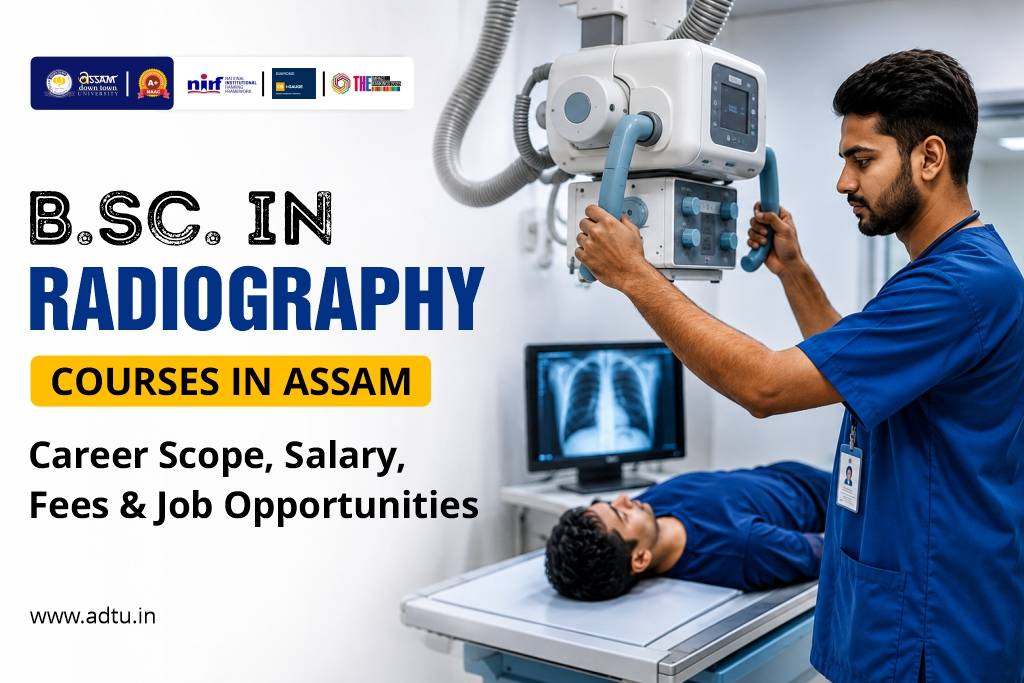
Every CT scan, MRI, and X-ray a doctor reads was actually captured by someone else first, a radiographer. That's the part most people never think about until they're choosing a healthcare course themselves. A radiography course in Assam has quietly become one of the more practical, technology-leaning options in allied health, and this guide walks through what it costs, what it pays, and where it can actually take you.
B.Sc. in Radiography, also called B.Sc. in Radiology and Imaging Technology, trains students to operate the equipment that produces medical images, X-ray, CT, MRI, ultrasound, mammography, and more, along with the positioning, safety, and image-processing skills needed to get a usable, accurate scan every time. It usually runs 3 to 4 years, often structured as three years of academic study plus a year of supervised hospital internship, depending on the university. You come out understanding both the physics behind the imaging and the practical, patient-facing side of actually running the machine.
Diagnostic imaging sits right at the centre of how modern healthcare actually works now, almost every serious diagnosis gets confirmed or ruled out with an image of some kind. As hospitals and diagnostic chains keep expanding, even into smaller cities, the demand for trained radiographers has grown right alongside them. The UK's NHS, Australia, Canada, and Gulf-region hospitals are all dealing with chronic radiographer shortages, which has opened up genuine international opportunities for Indian-trained graduates who weren't really part of this conversation a decade ago.
The coursework blends physics-heavy theory with a lot of hands-on machine time. You'll study radiation physics and safety, human anatomy specifically as it relates to imaging, patient positioning techniques, and contrast media administration. Beyond the core imaging modalities, X-ray, CT, MRI, ultrasound, mammography, most programmes also cover image post-processing and PACS systems, the software hospitals actually use to store and share scans. Clinical training, usually through hospital rotations across different imaging departments, tends to make up a big chunk of the final year.
Fees vary a lot depending on whether you're looking at a government or private institution, and honestly, this is true across India generally, not just in Guwahati specifically:

Government seats are cheaper but limited and competitive, which is exactly why private options have grown so much in this space. For Guwahati specifically, it's worth getting the current fee sheet directly from each college you're shortlisting, including AdtU, since these figures shift every academic year and aren't always kept updated on comparison sites.
If you like science but don't want years of clinical practice the way MBBS or nursing demands, radiography sits in a genuinely comfortable middle ground. You're working directly in patient care and diagnosis, but the day-to-day is more technical and equipment-focused than bedside. It's also a faster route into a stable healthcare salary than most other allied health degrees, and the skillset translates well if you ever want to specialise further into MRI, CT, or Sonography specifically.
Radiography rewards students who like working with technology as much as with people. You get real exposure to expensive, advanced equipment most students never touch otherwise, a genuine technical skillset that's hard to automate away, and a career path with room to specialise, MRI, CT, interventional radiology, without needing to start over with a new degree. It's also one of the more portable allied health qualifications internationally, which matters if working abroad is ever part of your plan.
Radiographers work well beyond hospitals, which surprises a lot of students going in. Diagnostic chains, standalone imaging centres, cancer treatment facilities, and research institutions all hire imaging-trained staff, and larger hospital networks increasingly want people cross-trained across two or three modalities rather than just one. As diagnostic infrastructure keeps expanding into tier-2 and tier-3 cities, that scope keeps widening geographically too, not just in metros.
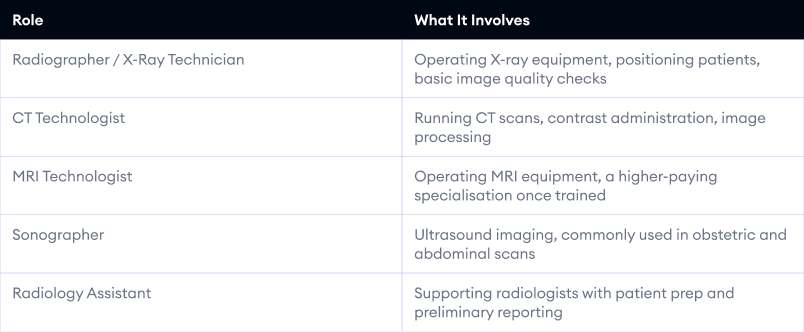

Specialisation genuinely moves the needle here. A general X-ray technician and an experienced MRI technologist can be earning quite different salaries despite starting from the same base degree.
AdtU offers both Bachelor's and Master's programmes in Medical Radiology & Imaging Technology. The programme runs within a university holding NAAC A+ accreditation (CGPA 3.34) and UGC recognition, with dedicated laboratory and clinical training infrastructure built into the course. AdtU's placement function operates university-wide too, and the 2026 outgoing batch recorded 900+ offers through 150+ recruiters. If you're comparing a radiology course in Guwahati against other options, current fees and seat availability for the Radiography programme are best confirmed directly through apply.adtu.in, since these get revised every academic year.
Yes. Diagnostic imaging is central to modern healthcare, demand keeps growing as hospitals and diagnostic chains expand, and the qualification also opens international opportunities, since countries like the UK and Australia currently face genuine radiographer shortages.
It's an undergraduate degree that trains students to operate medical imaging equipment, X-ray, CT, MRI, and ultrasound, and to produce accurate, diagnostically useful images, combining physics-based theory with substantial hands-on clinical training.
For most institutions currently, no, admission runs on Class 12 PCB marks or a university-specific process. That said, allied health entry rules are actively evolving under NCAHP, so it's worth confirming the current requirement directly with your specific institution before applying.
Yes. Government hospitals, AIIMS institutions, and state health departments regularly recruit radiographers and imaging technologists, typically through the standard central or state Pay Matrix structure for allied health roles.
Yes, this is essentially the core of the job. Graduates are trained across multiple imaging modalities during the course, and many go on to specialise further in one, MRI and CT in particular tend to pay more once you've built that specific expertise.
Yes. Clinical and laboratory-based training is built into AdtU's Medical Radiology & Imaging Technology programme, giving students hands-on exposure to imaging equipment and hospital-based practice as part of the course itself.


