


Top Engineering Colleges in Assam with Good Placem...
08th Oct 2026
A regular CSE degree still opens plenty of doors. But right now, the roles paying the most, and growing the fastest, sit specifically inside AI and data science, not general software development. This guide walks through what that specialisation actually leads to, role by role, without pretending every job title in this space means exactly one thing.
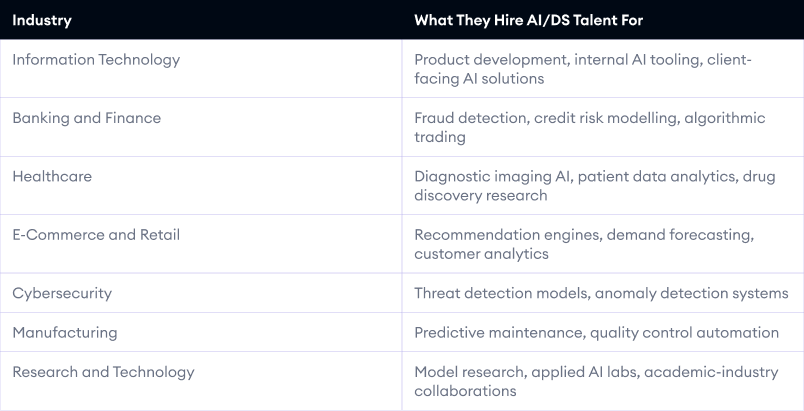
Generative AI adoption inside Indian companies has moved faster than almost anyone predicted three years ago, and it's pulled hiring budgets along with it. India's AI market alone is projected to cross USD.17 billion by 2027, and demand has genuinely outpaced the supply of engineers who can take a model from a Jupyter notebook to something running reliably in production. One honest thing worth knowing upfront: job titles in this space, AI Engineer, ML Engineer, Data Scientist, overlap a lot and get used inconsistently across companies. What actually determines your pay isn't the title on the offer letter, it's whether you can build, deploy, and maintain real systems, not just train a model in isolation.
Picking this specialisation at the undergraduate level, rather than bolting on an AI certification after a general CSE degree, means four years of building the actual mathematical and technical foundation, linear algebra, statistics, ML systems design, instead of cramming it in later through a six-week course. It also means your degree, internships, and final-year projects are all pointed in the same direction from day one, which tends to produce a stronger, more coherent portfolio by graduation than a generic CSE path with a late-stage AI pivot.
Since this is a specialisation within B.Tech CSE rather than a separately gated degree, standard B.Tech eligibility applies: 10+2 with Physics, Chemistry, and Mathematics, generally with a minimum aggregate around 45-50%, with some relaxation for reserved categories at most institutions. The programme runs the usual 4 years across 8 semesters, with the AI & Data Science specialisation typically beginning either from the first year or after a common foundational year, depending on the specific university's structure. Admission runs through JEE Main at many institutions, though a good number of private universities admit directly through their own entrance test or Class 12 merit instead, without requiring JEE, worth confirming directly with the specific college you're considering since this genuinely varies institution to institution.
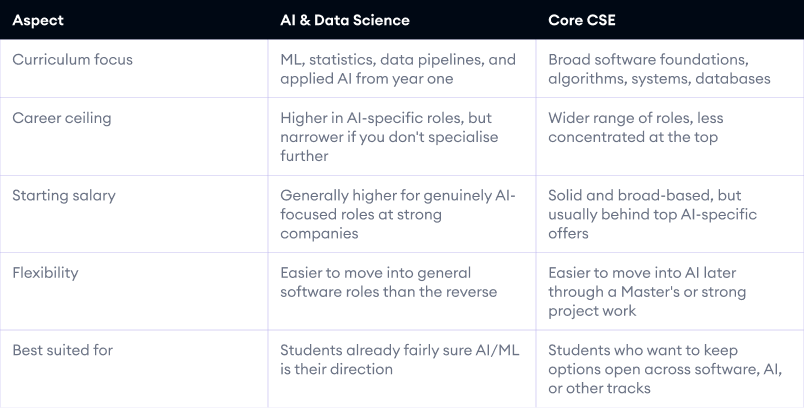
AI & Data Science isn't objectively "better" than Core CSE, it's more concentrated. If you're genuinely drawn to the field already, specialising early gives you a four-year head start over classmates who pivot into AI afterward. If you're still unsure, Core CSE keeps more doors open, and moving into AI later through a Master's or solid project work is a well-worn, realistic path, not a consolation prize for not choosing it upfront.
Builds and deploys AI systems into actual products, chatbots, recommendation engines, fraud detection, focused more on production and integration than pure research. Currently one of the higher-paying titles in this space, largely because deployment responsibility carries a real premium.
Designs and trains the models themselves, then works closely with AI engineers to get them into production. The line between this and an AI Engineer role blurs a lot in practice, and pay tends to track hands-on production experience more than the job title.
Spends more time on structured analysis, experiment design, and communicating findings to non-technical stakeholders than an ML Engineer typically does. Strong in companies where business decisions genuinely hinge on data interpretation, not just model accuracy.
The more accessible entry point into this whole field, working with existing datasets to find patterns and support business decisions, without necessarily building models from scratch. A common, realistic first job for fresh graduates building toward a data science role later.
Builds and maintains the data pipelines and infrastructure that AI and analytics teams actually depend on. Less visible than a data scientist role, but arguably just as essential, since no model or analysis works without clean, reliable data flowing into it.
A slightly more software-engineering-flavoured version of the ML Engineer role, focused on integrating AI capabilities into existing applications and products rather than researching new model architectures.
Translates data into dashboards and reports that actual business teams use to make decisions, less deep-technical than the roles above, but a genuinely solid, stable entry point, particularly into BFSI and retail.
A specialised track focused specifically on image and video-based AI, security systems, medical imaging, autonomous vehicles. Narrower than general ML roles, but strong computer vision skills command a real premium given how few engineers specialise this deeply.
Python remains the baseline language almost everyone in this field needs, alongside solid SQL for working with data at all. Strong statistics and linear algebra fundamentals matter more here than in general CSE, since they're what separate someone who can tune a model from someone who actually understands why it works. Familiarity with frameworks like TensorFlow and PyTorch, cloud platforms (AWS, GCP, Azure), and increasingly, basic MLOps, actually deploying and monitoring models in production, round out what recruiters look for beyond the coursework itself.
Coursework alone rarely convinces a recruiter. A handful of project types genuinely move the needle: an end-to-end ML pipeline, data collection through deployment, not just a notebook that stops at model accuracy; a Kaggle competition entry, since it's a recognisable, comparable benchmark of skill; a small GenAI project, a RAG-based chatbot or a fine-tuned open-source model, given how fast this specific area is growing; a computer vision project if that's your interest, object detection or image classification on a real dataset; and a clean, well-documented data visualisation dashboard, since business communication skills matter as much as the modelling itself.
This isn't a stretch claim, there's real, specific substance behind it. IIT Guwahati now runs a dedicated Mehta Family School of Data Science and Artificial Intelligence, and researchers from it presented original AI research at ICML 2026 in Seoul, one of the field's top global conferences, alongside genuine scholars, not just coursework. The Assam government has rolled out its own AI-IT Policy 2025 and signed a partnership with Google Cloud to establish an AI Centre of Excellence in the state. Guwahati was also chosen to host a Human Capital Working Group Meeting as an official regional precursor to the India AI Impact Summit 2026 in New Delhi, putting the city on the national AI policy map, not just the tech-hiring map. Add the Rs. 4.91 lakh crore in investment commitments from the Advantage Assam 2.0 summit, and the region is building real AI-relevant infrastructure, not just hoping talent shows up on its own.
AdtU's B.Tech CSE offers a dedicated AI & ML specialisation built with IBM, giving students access to industry certifications, IBM-designed coursework, and structured mentorship rather than a generic add-on syllabus. That sits on top of NAAC A+ accreditation (CGPA 3.34), UGC/AICTE recognition, and a placement record of 900+ offers through 150+ recruiters for the 2026 outgoing batch. For students weighing a b tech in artificial intelligence and data science against options in Assam or across the wider Northeast, a named industry partnership specifically for AI, in a region that's actively building its own AI ecosystem right now, is a genuinely strong combination. Admissions details are at apply.adtu.in.
Yes. With India's AI market projected to cross USD.17 billion by 2027 and demand for deployment-ready talent outpacing supply, this specialisation currently offers some of the strongest salary growth within computer science.
Generative AI adoption across Indian industry has grown extremely fast, and companies need engineers who understand both the modelling and the production side, a combination general CSE graduates often have to learn separately, after graduation.
Yes. An M.Tech or M.S. in AI, Machine Learning, or Data Science is a natural next step for research-focused students, though many graduates move straight into industry roles and build expertise through certifications and project work instead.
Not better, more specialised. Data science offers stronger salary growth in AI-specific roles right now, but core CSE knowledge, algorithms, systems design, remains the foundation that makes advanced data science and ML work actually possible.
Python, by a wide margin, given its dominance in machine learning frameworks and data analysis libraries. Strong SQL knowledge is essential too, alongside familiarity with R for certain statistics-heavy analytical roles.
Yes, significantly more than in general software roles. Linear algebra, probability, and statistics form the actual foundation of how machine learning models work, and a weak grasp here tends to cap how far someone can grow beyond entry-level roles.


