


Top Engineering Colleges in Assam with Good Placem...
08th Oct 2026

Torn between B.Pharm and D.Pharm? Most students land on this question without realising both are perfectly legitimate ways into the same profession, just at different depths and different timelines. One gets you working faster, the other opens a lot more doors later.?
Medicines don't stop being needed when the economy slows down, which is part of why pharmacy holds up better than a lot of other career choices during uncertain times. India's pharmaceutical industry is the third largest in the world by volume, and between expanding hospital networks, a growing retail pharmacy market, and pharmaceutical manufacturing that keeps scaling up, demand for trained pharmacy professionals, at every level, keeps climbing rather than levelling off.
Both are regulated by the Pharmacy Council of India, and both lead to a real, respected pharmacy career, but they're built for different goals. D.Pharm is the shorter, faster route in, built around getting you registered and working as a pharmacist as quickly as possible. B.Pharm takes twice as long but opens up a genuinely wider set of roles, pharmaceutical manufacturing, quality control, regulatory affairs, research, not just dispensing medicines across a counter. Neither is a dead end either. D.Pharm graduates can move into B.Pharm later through lateral entry, so an early choice doesn't lock you out of the other path.
B.Pharm is a 4-year undergraduate degree covering pharmaceutical chemistry, pharmacology, pharmaceutics, and drug regulation in real depth, well beyond what a diploma can cover in two years. Admission generally requires 10+2 with Physics, Chemistry, and Biology or Maths, and many colleges use entrance exams or state-level CETs alongside merit-based routes. Graduates walk away eligible for a much wider range of roles than D.Pharm holders, production, quality assurance, regulatory affairs, and pharmaceutical sales, on top of the dispensing and hospital pharmacy roles both degrees share.
D.Pharm is a 2-year diploma, built to get students registered and working as a licensed pharmacist as directly and quickly as possible. It requires the same basic 10+2 science background, and includes a substantial practical training component, often 500-plus hours, focused on dispensing, patient counselling, and day-to-day pharmacy operations. Most D.Pharm graduates end up working in retail pharmacies, hospital pharmacies, or clinics, and a fair number eventually run their own medical store once they've built enough experience and capital.

Neither course requires NEET, since pharmacy sits under the Pharmacy Council of India, a separate regulatory body from the medical and allied health councils that use NEET.
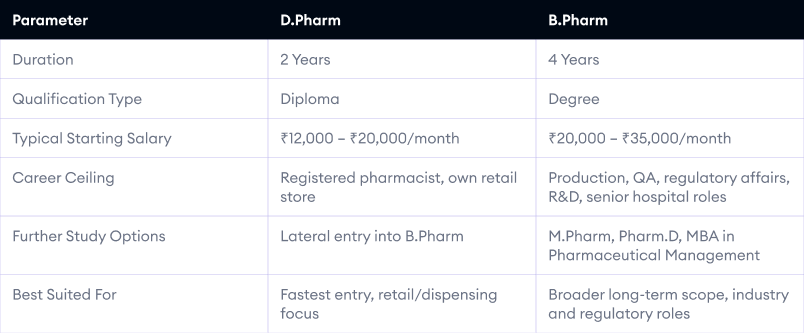
If getting into paid work as quickly as possible matters most, and you're comfortable with retail or hospital dispensing as your day-to-day, D.Pharm gets you there in half the time. If you're aiming at pharmaceutical manufacturing, quality control, regulatory affairs, or eventually a Drug Inspector post, B.Pharm is genuinely the better foundation, since several of those roles simply aren't open to diploma holders. And if you're not fully sure yet, that's fine too, D.Pharm followed by lateral entry into B.Pharm is a well-established, commonly used path that lets you start earning sooner without permanently narrowing your options.
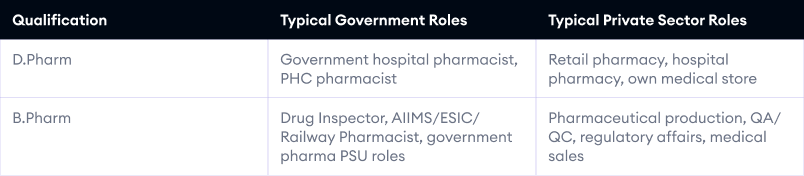
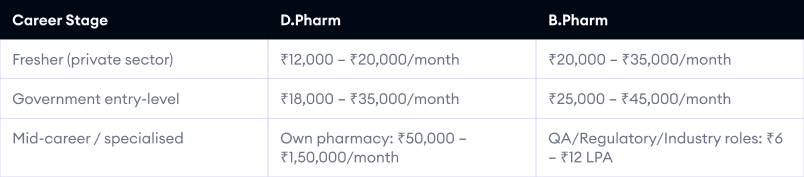
B.Pharm graduates typically out-earn D.Pharm holders by a wide margin in salaried roles, though D.Pharm holders who eventually run their own pharmacy can, in some cases, out-earn a salaried B.Pharm employee, just through a different route entirely.
B.Pharm graduates have the most higher-study options: M.Pharm for specialisation in areas like pharmacology or clinical research, Pharm.D for a more clinically-focused, internationally recognised path, or even an MBA in Pharmaceutical Management for students who want to move toward business and leadership roles within the industry. D.Pharm holders aren't stuck either, lateral entry into B.Pharm remains the most common next step, after which the same M.Pharm and D.Pharm routes open up.
AdtU runs the full pharmacy ladder, D.Pharm, B.Pharm, and M.Pharm, on one campus, which means a student can start with the shorter diploma and work up to a postgraduate qualification without ever switching institutions. The programmes sit within a university holding NAAC A+ accreditation (CGPA 3.34) and Pharmacy Council of India recognition, backed by dedicated pharmacy labs and a placement function that secured 900+ offers through 150+ recruiters for the 2026 outgoing batch, including pharma names like Sun Pharma. For students comparing B.Pharm colleges in Assam or looking specifically at b pharm university options in Guwahati, that combination of a full D.Pharm-to-M.Pharm pathway and an active placement office is worth real weight. Current fee details, including for D.Pharm, are best confirmed directly through apply.adtu.in, since these are revised every academic year.
Neither is universally better, it depends on your goals. D.Pharm gets you working fastest, in half the time, while B.Pharm opens a much wider set of roles across pharmaceutical manufacturing, regulatory affairs, and research, along with meaningfully higher long-term salary potential.
Yes, through lateral entry, most colleges allow D.Pharm graduates to join B.Pharm directly in the second year, letting you upgrade to the full degree without repeating the initial coursework.
B.Pharm generally pays significantly more in salaried roles, often 40-80% higher than D.Pharm at comparable experience levels, particularly in pharmaceutical industry and regulatory positions that aren't open to diploma holders at all.
B.Pharm opens the widest range of government roles, including Drug Inspector positions, though D.Pharm holders can still access government hospital and PHC pharmacist posts, just with a narrower set of options overall.
Yes. D.Pharm graduates can register as licensed pharmacists after completing the diploma and required registration formalities, which is enough to work in retail or hospital pharmacy roles or eventually run your own medical store.
AdtU offers the complete D.Pharm-to-M.Pharm pathway on one campus, backed by NAAC A+ accreditation, Pharmacy Council of India recognition, and a placement record of 900+ offers through 150+ recruiters for the 2026 batch, including pharmaceutical industry recruiters.


