


Top Engineering Colleges in Assam with Good Placem...
08th Oct 2026
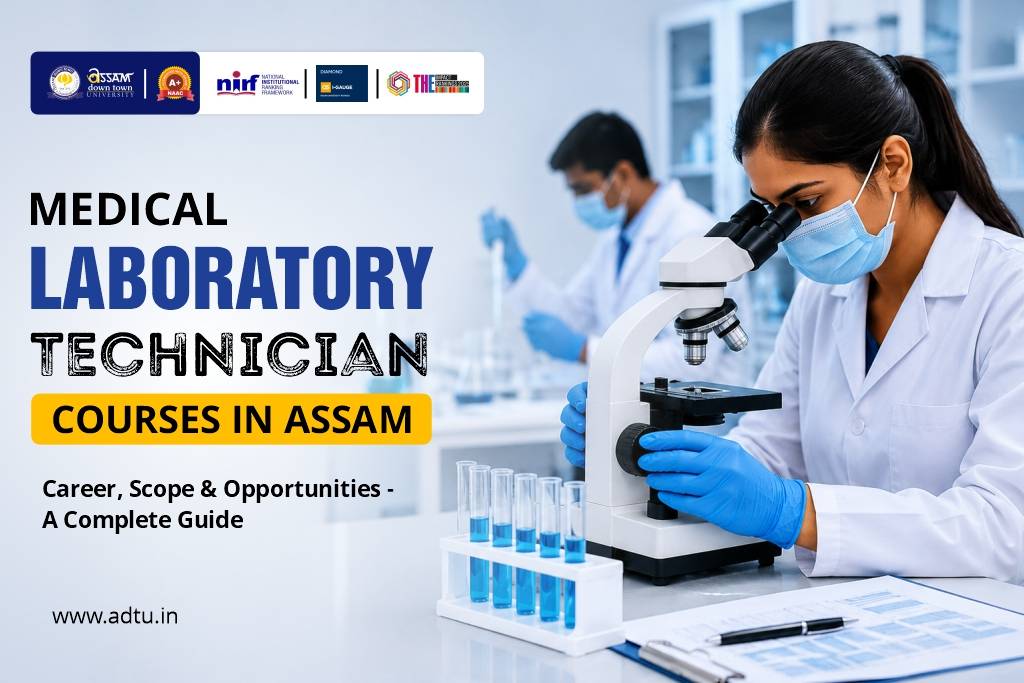
Roughly 70% of medical diagnoses depend on a laboratory test result, not a doctor's eye alone. That's the entire case for medical laboratory technology as a career, and it's why medical laboratory technician courses have quietly become one of the more dependable healthcare paths a student can choose after Class 12. This guide covers what the field actually involves, which course to pick, and what it looks like specifically for students in Assam.
Medical Laboratory Technology sometimes grouped under Medical Laboratory Science, trains students to collect, process, and analyse biological samples, blood, urine, tissue, and more, using the instruments and techniques that generate the test results doctors actually diagnose from. You'll come out knowing biochemistry, microbiology, and hematology at a practical level, alongside how to actually run a lab safely and accurately, not just understand the theory behind it. It's worth knowing the field now sits under the official "Allied and Healthcare" category, the term that replaced the older "paramedical" label a couple of years back, though you'll still see both used interchangeably online.
India's diagnostics industry is now estimated at around Rs.1 lakh crore, and it keeps growing as more hospitals, standalone diagnostic chains, and NABL-accredited labs open across the country, even in smaller cities. That growth translates directly into demand for trained lab professionals, since every one of those facilities needs qualified staff to actually run the tests. The career scope stretches well beyond a single hospital job too, diagnostic chains, pathology labs, research institutions, and blood banks all recruit from the same talent pool, which gives graduates real flexibility in where they end up working.
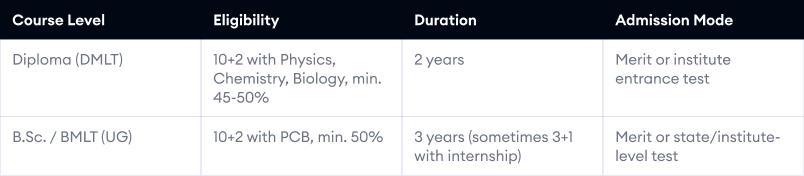
NEET is generally not required for either route; admission runs on your Class 12 science marks or a college-specific entrance process instead, though it's always worth confirming the current policy with the specific university before applying.
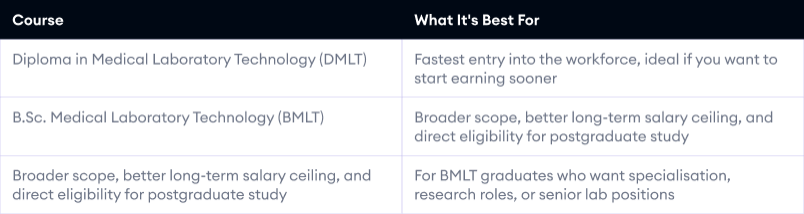
DMLT holders aren't stuck either, many universities allow lateral entry into the second year of a BMLT programme if they want to upgrade later.
The degree route exists because three years genuinely builds a different level of competence than a two-year diploma does, particularly once you get into the clinical training portion, where a majority of contact hours by the final year happen inside an actual working lab, not a classroom. Core subjects include Clinical Biochemistry, Hematology, Microbiology, and Pathology, alongside dedicated modules on clinical laboratory techniques and instrumentation. All of it is paired with structured practical and clinical training, usually through hospital or diagnostic centre placements, so graduates leave having actually run the tests they'll be doing on the job, not just read about them.
A few things make this degree genuinely worth the three years:
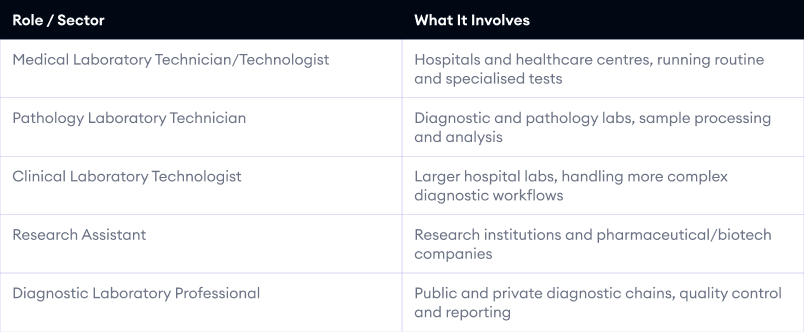
Graduates aren't limited to one type of employer, and the roles themselves range from entry-level to fairly senior:
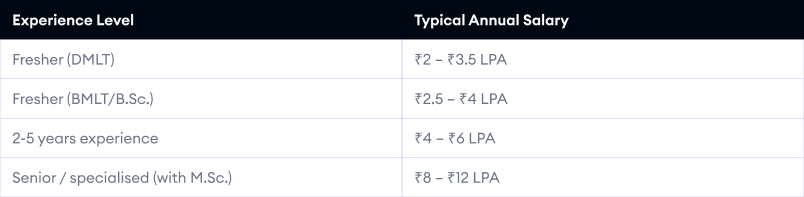
Salary depends heavily on a few things: government versus private employer, DMLT versus the fuller BMLT degree (which tends to start 25-35% higher), city and cost of living, and whether you've picked up a specialisation like microbiology or clinical biochemistry along the way.
Assam's healthcare sector has expanded meaningfully over the past few years, and Guwahati in particular has grown into a genuine diagnostic and hospital hub for the entire Northeast, not just the state. That growth means real local demand for trained MLT professionals across diagnostic centres, multi-speciality hospitals, and pathology chains, rather than students needing to leave the region to find decent lab work. It's not limited to the city either, district-level hospitals and diagnostic centres across the Northeast increasingly need qualified lab staff too, which widens the realistic career map well beyond Guwahati alone.
A few checks matter more than a college's marketing materials
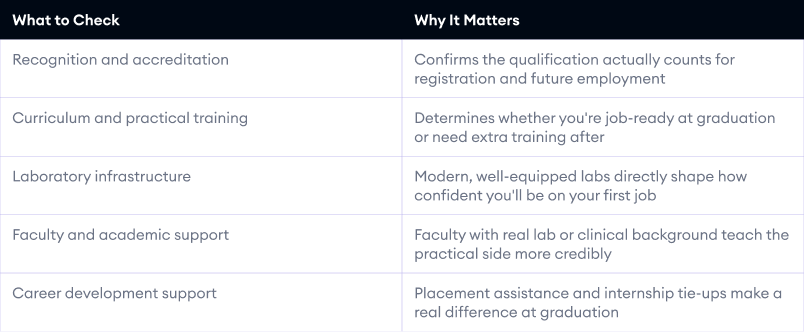
A good Medical Laboratory Technology course should give students plenty of opportunities to learn by doing, not leave practical work for the very end. That is one of the things to look at when considering AdtU. Along with the academic part of the programme, students receive practical and clinical training and get access to laboratory facilities during their course. The faculty also brings both academic and clinical experience into the classroom, which can help students understand how the concepts they learn are used in actual laboratory settings.
AdtU is NAAC A+ accredited with a CGPA of 3.34 and recognised by the UGC. Its 2026 outgoing batch also recorded 900+ placement offers from 150+ recruiters across the university.
Yes. Guwahati’s role as the healthcare and diagnostic hub for the Northeast, along with the steady need from all hospitals and diagnostic centers across the state, makes it a very stable and relevant choice.
Extremely. This is a hands-on profession, students who get real lab and clinical exposure during their course, not just classroom theory, tend to be far more job-ready and confident when they start working.
Yes, in some institutions students who have completed a DMLT may be eligible for lateral entry into the BMLT programme, often from the second year. The exact entry point and eligibility, however, depend on the university criteria, so it is worth checking before applying.
That really comes down to what you want to do next. DMLT is a shorter route into laboratory work, while BMLT gives you a degree and can open up more options later, including higher studies. If you want to start working sooner, DMLT may make more sense. If you are thinking about building a longer-term career in the field, BMLT is worth considering.
An M.Sc. is a common next step. Depending on your area of interest, you can look at M.Sc. Medical Laboratory Technology, Clinical Biochemistry, Microbiology and related fields.
Yes. Diagnostic centres are one of the places where MLT graduates commonly find work. Hospitals, pathology laboratories and blood banks are other options.
There is scope to grow, although the starting salary may not be very high. With experience, further study and a specialisation, your opportunities can improve. Areas such as microbiology, clinical biochemistry and other specialised laboratory functions can also lead to more senior roles over time.


