


Top Engineering Colleges in Assam with Good Placem...
08th Oct 2026

Civil engineering in 2026 isn't the slow, traditional branch it's sometimes still assumed to be. Between a Rs.111 lakh crore infrastructure pipeline, genuine international demand, and a fast-growing BIM-driven digital layer that's reshaping who earns what, the civil engineer's future scope looks considerably stronger than it did even five years ago. What civil engineers can do today spans structural design, smart city planning, sustainability consulting, and digital modelling, not just site supervision. Picking the right specialisation, and a university with a real industry partnership behind it, matters more than ever for turning that scope into an actual career.
The clearest proof isn't a survey, it's admission cutoffs. IIT Bombay's civil engineering programme opened at All India Rank 385 in JoSAA 2026, compared to rank 2,244 just two years earlier. That's not a small shift, and it reflects something real with a Rs.111 lakh crore infrastructure pipeline and a construction market racing toward $2 trillion by 2029, demand for civil engineers is growing faster than most other engineering branches right now. Metro expansions, expressway corridors, and renewable energy infrastructure are all adding roles at once, across government and private employers alike.
Within India, the scope stretches across metro rail projects, national highway corridors, smart city development, and renewable energy infrastructure, sectors that barely existed as civil engineering specialisations a decade ago. Abroad, the picture is even more lucrative for engineers willing to relocate. The UAE and Canada in particular offer significantly higher packages, often Rs.25-60 LPA for experienced professionals, and global EPC firms like AECOM, Bechtel, Jacobs, and Mott MacDonald actively recruit India-trained civil engineers for international infrastructure projects.
Software fluency has become just as important as core engineering knowledge now. AutoCAD and STAAD.Pro remain the baseline expectation, but Revit, Civil 3D, and BIM (Building Information Modelling) are where the real salary premium sits, more on that shortly. Beyond software, strong surveying skills, basic project management competence, and the ability to actually communicate technical decisions to non-technical stakeholders, clients, contractors, local authorities, all separate engineers who get promoted quickly from those who plateau at a technical role.
Structural engineers design the load-bearing bones of buildings and bridges, and this remains one of the highest-paying specialisations in the field, particularly for engineers working on seismic-resistant or high-rise projects, where specialised expertise commands a real premium.
The hands-on, on-ground role, managing daily construction activity, coordinating contractors, and making sure a project actually gets built the way it was designed. It's usually the starting point for engineers who later move into project management.
Overseeing budgets, timelines, and teams across an entire project, this is one of the better-paying roles in civil engineering, and one most engineers grow into after several years of site or design experience rather than starting in directly.
Focused on roads, highways, railways, and metro systems, a specialisation that's seen sustained demand thanks to India's expressway and metro expansion push, and one that increasingly overlaps with smart-mobility and traffic-technology work.
Working on water systems, waste management, and pollution control, this role has grown in importance as environmental compliance requirements have tightened across Indian infrastructure projects over the past few years.
Studying soil and rock behaviour before construction begins, a specialised, less crowded field that tends to reward deep technical expertise with strong long-term earning potential.
Working on how cities actually grow and function, land use, zoning, public infrastructure layout, a role that sits at the intersection of civil engineering and public policy, and one that's gaining relevance as India's Smart Cities Mission expands.
Managing project costs, budgeting, and contracts, a less technically glamorous but genuinely well-paid specialisation, since every construction project needs someone keeping the finances under control.
Green building certification, energy-efficient design, and low-carbon materials have moved from niche interest to mainstream expectation, and engineers with genuine sustainability expertise are increasingly commanding a real premium for it.
India's Smart Cities Mission has created a whole category of civil engineering work around integrated urban infrastructure, IoT-enabled utilities, smart traffic systems, digital infrastructure planning, that didn't really exist as a specialisation before.
Consulting firms advising on large infrastructure projects, feasibility, design review, risk assessment, offer some of the more intellectually varied career paths in civil engineering, often at a meaningfully better salary than a pure execution role.
This is the one worth paying real attention to. The Indian government now mandates BIM on all central government construction projects above Rs.100 crore, covering CPWD, NHAI, Smart Cities Mission, and MoRTH projects, and BIM job postings in India have grown by roughly 55% between 2024 and 2026 alone. India is projected to need over 5 lakh skilled BIM professionals by 2030, and BIM-trained civil engineers currently earn a 35-45% salary premium over peers without that skill. If there's one specialisation to prioritise right out of college, this is probably it.
Construction and EPC (engineering, procurement, construction) companies remain the largest single employer category, alongside real estate developers building both residential and commercial projects. Infrastructure consulting firms, renewable energy companies building solar and wind installations, and government departments and PSUs round out the rest, and increasingly, transportation and logistics companies are hiring civil engineers directly into infrastructure planning roles too.
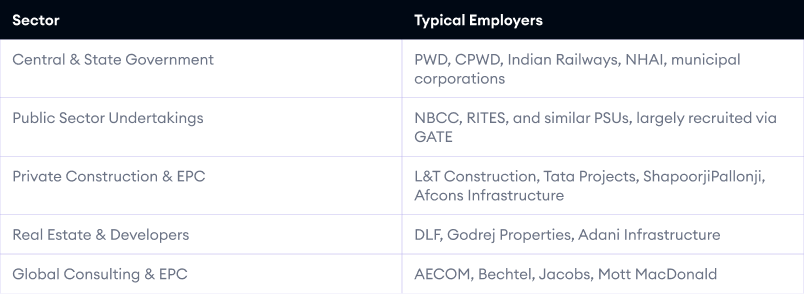
Government roles tend to offer strong job security and steady, allowance-backed pay, while private and consulting roles generally offer faster salary growth for engineers willing to specialise.
AdtU'sB.Tech Civil Engineering is built with L&T, one of the same major infrastructure players that shows up repeatedly on India's list of top civil engineering recruiters, covering specialisations in Advanced Practices in Construction and Integrated Building System Design. That industry link matters more than a generic curriculum would, since it's built around what an actual construction major is hiring for, not just a textbook syllabus. The programme sits within a university holding NAAC A+ accreditation (CGPA 3.34) and UGC/AICTE recognition. For students weighing civil engineering specialisation courses and where to study them, that combination of a named industry partner and a functioning placement office is worth real consideration. Admissions details are at apply.adtu.in
Not always. Many roles, site engineering, construction management, transportation engineering, are accessible directly after a B.Tech. An M.Tech or specialised certification (like BIM or structural analysis) becomes more valuable for research, teaching, or highly specialised technical roles.
Yes. With Rs.111 lakh crore committed to infrastructure and rising admission cutoffs at top institutes, demand is genuinely strong, particularly for engineers who combine core skills with digital tools like BIM.
Freshers typically start between Rs.3-5 LPA, with mid-career engineers earning Rs.9-18 LPA and senior professionals reaching Rs.15-45 LPA depending on specialisation, employer, and location. Specialised skills like BIM can add a 35-45% premium on top of that.
BIM, structural engineering, and construction project management currently offer the strongest salary growth, though the "best" choice really depends on whether you prefer design-heavy, site-based, or technology-driven work.
Structural and transportation engineering tend to align most closely with PWD, CPWD, and NHAI recruitment needs, while general civil engineering knowledge through GATE opens doors to PSUs like NBCC and RITES as well.
Yes, arguably one of the strongest right now. With a government mandate on projects above Rs.100 crore, 55% growth in BIM job postings since 2024, and a 35-45% salary premium for BIM-trained engineers, it's one of the highest-return skills a civil engineering graduate can pick up.
Yes, and many experienced civil engineers eventually do, typically after building enough site or project experience to run independent contracting, consulting, or design firms. It usually takes a few years of hands-on experience first to build the credibility and network needed.Insert your text here


