


Top Engineering Colleges in Assam with Good Placem...
08th Oct 2026
People predicted mechanical engineering would fade as software ate the world. B.Tech in Mechanical Engineering is having a genuinely strong moment right now, pulled along by electric vehicles, robotics, defence manufacturing, and a renewable energy push that all need mechanical engineers at the core of them, not on the side. Freshers typically start around Rs. 2.5-5 LPA, with specialised roles in EV, aerospace, or robotics reaching Rs. 20-35 LPA or more with experience. The rest of this guide gets into why, and what it actually looks like on the ground.
Mechanical engineering is often called the "mother branch" of engineering, and that's not just a nice phrase, it's genuinely the field that touches machines, manufacturing, engines, thermal systems, and production across almost every industry that exists. A B.Tech in Mechanical Engineering is a 4-year undergraduate degree covering thermodynamics, fluid mechanics, machine design, manufacturing processes, and increasingly, the digital tools, CAD, simulation, automation, that modern mechanical work actually runs on. It's a broad foundation by design, which is exactly why graduates end up in industries as different as automotive, aerospace, energy, and consumer manufacturing.
To pursue a B.Tech in Mechanical Engineering, students generally need to have completed Class 12 with Physics and Mathematics along with Chemistry or another relevant subject, depending on the university's admission rules. Most colleges also set a minimum percentage requirement for admission. Students from recognised boards can apply, but the exact eligibility criteria can differ between institutions, so it is important to check the requirements of the college before applying.
Admission to B.Tech Mechanical Engineering can happen through different routes. Students may enter through national or state-level engineering entrance exams, such as JEE Main or the relevant state entrance examination, while some private universities have their own admission process based on entrance tests, Class 12 marks or both. For students considering private B.Tech colleges in Assam, checking the university's current admission process and eligibility requirements is the simplest way to understand which route applies to them.
The cost of a B.Tech in Mechanical Engineering varies from one college to another in Assam. Apart from tuition fees, students should also consider expenses such as hostel accommodation, examination fees, laboratory charges and other university costs when comparing colleges. Since fee structures can change between academic years and differ by institution, students should check the latest figures directly with the university before making a decision. For AdtU, the current fee details can be checked through its official admission portal.
Make in India has set a target for manufacturing to contribute 25% of India's GDP by 2030, and that kind of ambition doesn't happen without a large, sustained mechanical engineering workforce behind it. Add India's EV market, expected to cross Rs. 20 lakh crore by 2030, and defence exports that already crossed Rs. 21,083 crore in FY2024, and the market size backing this branch is considerably larger than the "traditional, slow-growing" reputation it sometimes still carries.
Mechanical graduates aren't boxed into one type of role either. Design, manufacturing, quality control, R&D, project management, and increasingly, automation and robotics integration are all realistic paths from the same base degree, which gives mechanical engineers more flexibility to pivot mid-career than a lot of narrower branches allow.
Software fluency now sits alongside core mechanical knowledge as a baseline expectation. AutoCAD, SolidWorks, CATIA, and CREO for design work, ANSYS for structural and thermal analysis, and growing familiarity with IoT, robotics, and 3D printing, additive manufacturing, all separate strong candidates from average ones at placement time.
An M.Tech in thermal engineering, robotics, or design opens research and academic paths, but it's genuinely optional rather than required for most industry roles. A lot of mechanical engineers instead pick up focused certifications in CAD/CAM, robotics, or EV systems, which tend to move the salary needle faster than a general Master's would.
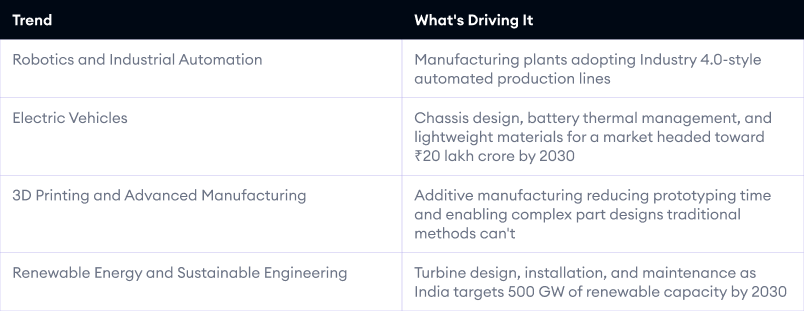
The field isn't standing still. Mechatronics, the blend of mechanical and electronics knowledge, has moved from a niche specialisation to something close to a baseline expectation in manufacturing-heavy roles. AI-enabled production management, simulation-driven design, and automation-first manufacturing floors mean today's mechanical engineer needs to be comfortable with software and data in a way that wasn't really true a decade ago.
Still the largest employer category by volume, covering design, production, and quality roles at companies ranging from traditional auto majors to the newer EV-focused manufacturers scaling up production right now.
Higher-paying, more specialised tracks, particularly at defence PSUs like HAL, DRDO, and BEL, or in energy infrastructure projects tied to India's renewable capacity targets.
The newest and fastest-growing path, spanning industrial robotics, automation system design, and the mechatronics-heavy roles that are increasingly what separates a premium salary offer from an average one.

Specialisation is really what drives the spread here. A mechanical engineer in a general manufacturing role and one working in EV battery systems or aerospace R&D can be earning quite different salaries off the same base degree.
Automobile majors, Tata Motors, Mahindra & Mahindra, Maruti Suzuki, and the growing list of EV-focused manufacturers, hire in real volume every placement season. Manufacturing and industrial giants like L&T, Siemens, Bosch, and Godrej recruit across design and production roles, and public sector heavyweights, BHEL, ONGC, IOCL, GAIL, hire through GATE for both engineering and management-track positions. Defence PSUs and private defence manufacturers round out one of the more stable, well-paying corners of the field.
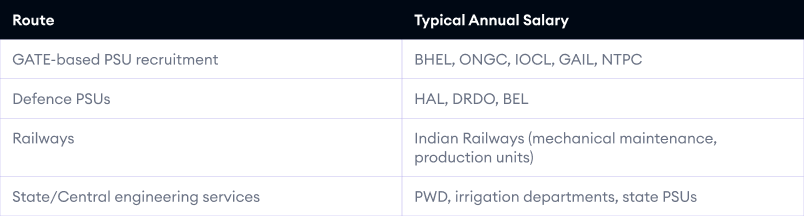
Government mechanical roles remain genuinely competitive to land, but they offer the kind of long-term stability and structured pay progression that private-sector roles don't always match.
This part surprises people who assume mechanical engineering opportunities only exist in Pune, Chennai, or the Delhi-NCR industrial belt. Numaligarh Refinery Limited, an Oil India Limited subsidiary based in Golaghat district, Assam, is in the middle of a mega expansion project that will nearly triple its refining capacity from 3 to 9 million tonnes per annum. That expansion is actively generating mechanical and chemical engineering recruitment right now, from Graduate Engineer Trainee intake through GATE to specialised technical postings and apprenticeships for mechanical engineering diploma holders. It's a genuine, large-scale, mechanical-engineering-heavy PSU operating right in Assam, not a hypothetical opportunity somewhere else in the country.
AdtU's B.Tech Mechanical Engineering is built with L&T, covering Integrated Solutions to Process Plant Engineering, a specialisation that lines up directly with the kind of refinery and industrial-process expansion happening at NRL and similar projects across the region. That industry link sits on top of NAAC A+ accreditation (CGPA 3.34) and UGC/AICTE recognition, backed by a placement function that secured 900+ offers through 150+ recruiters for the 2026 outgoing batch. For students comparing private B.Tech colleges in Assam, a named industry partnership tied to process and plant engineering, in a state with a genuine, expanding refinery sector, is a combination worth real weight. Admissions details are at apply.adtu.in.
Yes. With manufacturing targeted to reach 25% of India's GDP by 2030 and strong growth in EVs, robotics, and renewable energy, mechanical engineering remains one of the more versatile branches, especially for students who pair core skills with modern digital tools.
Yes. Domestically, automotive, defence, and energy sectors are all hiring actively, and internationally, mechanical engineers with specialised skills in robotics, EV systems, or aerospace are sought after by global manufacturing and technology companies as well.
Yes, and this is one of the fastest-growing paths right now. EV manufacturers need mechanical engineers for chassis design, thermal management, and battery system integration, roles that barely existed a decade ago in this volume.
Yes. Robotics and automation is growing at over 20% CAGR in India, and mechanical engineers with mechatronics skills, the blend of mechanical and electronics knowledge, are increasingly the ones landing the higher-paying roles in this space.
Yes, and increasingly so. Numaligarh Refinery Limited's expansion from 3 to 9 MMTPA is generating real mechanical and chemical engineering jobs within Assam itself, alongside the broader industrial growth happening across the region.
AdtU's B.Tech Mechanical Engineering is built with L&T around process plant engineering, backed by NAAC A+ accreditation and a placement record of 900+ offers through 150+ recruiters for the 2026 batch, giving Northeast India students an industry-linked option without relocating.


