


Top Engineering Colleges in Assam with Good Placem...
08th Oct 2026
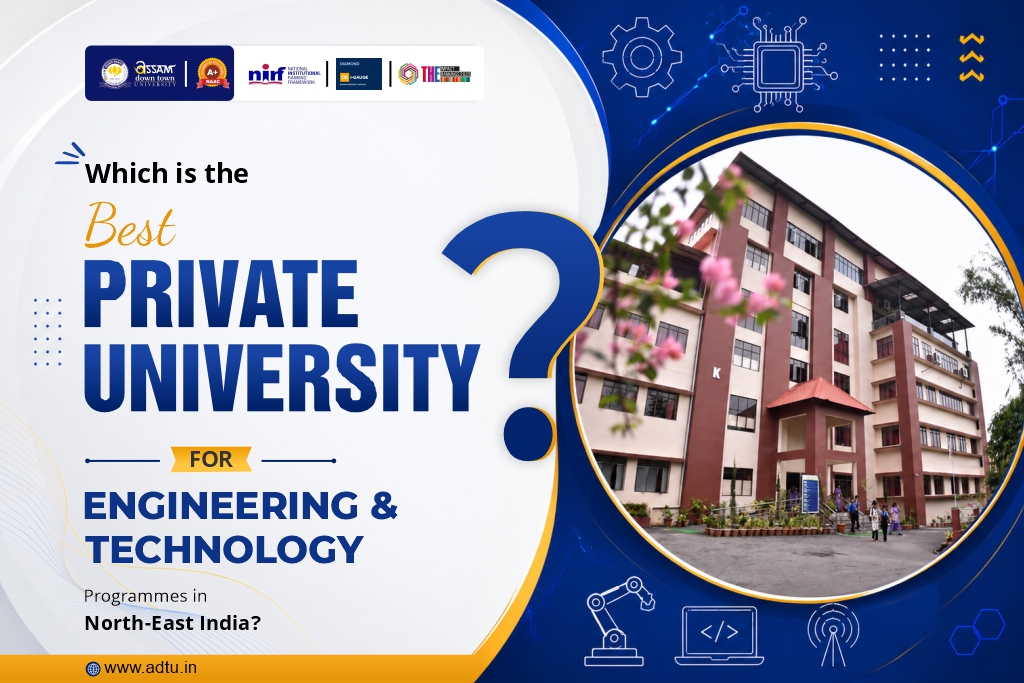
Searching for the best private university for engineering in North-East India? This guide breaks down what actually matters, accreditation, industry tie-ups, and placements, and shows exactly where AdtU fits into that picture.
For a long time, students from Assam, Meghalaya, Nagaland, Manipur, and the rest of the region had a familiar routine: finish Class 12, pack a bag, and head to Bangalore, Pune, or Delhi for engineering. That's changing, and it's changing fast.
Over the last decade, engineering colleges in North-East India have started closing the gap with metro-city institutions. Better labs, tie-ups with global companies, and updated curriculum have made it possible to get a solid B.Tech without leaving the region. Guwahati, in particular, has emerged as the hub for this shift, with a handful of private universities in North-East India now offering programmes that were once only available outside the region.
But not all of them are built the same way, and "private university" alone doesn't tell you much about quality. That's where it helps to know what to actually look for before shortlisting engineering admission options in North-East India.
Ask ten people what makes an engineering college good, and you'll get ten different answers. Strip away the noise, though, and a few things consistently separate the strong engineering and technology programmes from the average ones.
Accreditation and recognition: NAAC grades, UGC recognition, and AICTE approval aren't just certificates for a wall. They're a signal that the university has been independently evaluated on teaching quality, infrastructure, and governance.
Industry partnerships: Plenty of B.Tech colleges in North-East India list "industry partnerships" in their brochures. Far fewer actually bring in companies to co-design curriculum, run labs, or offer certifications that recruiters recognise.
Placement record: A single good year doesn't prove much. Consistent placement numbers across specialisations, and across batches, tell a more honest story about the quality of engineering education on offer.
Specialisations: Cybersecurity, AI, and core branches like Civil and Mechanical still matter; the question is whether the university has updated what's taught inside them.
Faculty and mentorship: Class sizes, faculty-student ratios, and whether professors are reachable outside of lecture hours all affect the actual day-to-day experience of an engineering degree.
Assam down town University is the first NAAC A+ accredited private university in North-EastIndia, which already puts it in a different category from most of its regional peers.
Its engineering and technology programmes have been built with an eye on industry relevance rather than just adding specialisations for the sake of variety. The B.Tech in Civil and Mechanical Engineering runs in partnership with L&T EduTech, giving students exposure to how these disciplines are actually practised on live projects, not just in textbooks.
On the computer science side, the B.Tech CSE offers industry-aligned specialisations including Cybersecurity with LTM, AI & ML with IBM, and Cloud ERP with SAP, all developed alongside some of the sector's larger IT services and consulting names. Students who want to go further can opt for the M.Tech in CSE, with specialisations in Artificial Intelligence & Machine Learning and Data Science & Analytics.
AdtU's placement numbers back up this industry-facing approach to engineering education for the outgoing batch of 2026, the university recorded 900+ placement offers through 150+ recruiters, across more than 60 programmes university-wide. Partners on the recruitment and training side include SAP, IBM, L&T EduTech, LTM, and VFS Global, giving engineering students a realistic shot at both core and IT-sector roles.
For a region that has historically sent its brightest engineering aspirants elsewhere, that combination of accreditation, industry design, and placement outcomes makes AdtU a strong contender for anyone comparing the best engineering colleges in North-East India.
This comparison comes up in almost every family conversation about engineering admission in North-East India, and honestly, there isn't one universal right answer.
Government colleges in the region, like NIT Silchar or NIT Meghalaya, still carry strong brand recognition and typically cost less. But seats are limited, competition is intense, and curriculum updates can move slowly given the scale at which these institutions operate.
Private universities in North-East India like AdtU tend to offer more flexibility in how quickly a curriculum adapts, more direct access to industry partnerships, and often, smaller class sizes that allow more one-on-one mentorship. The tradeoff is usually a higher fee structure, though scholarships and education loans have made this gap smaller than it used to be.
The honest way to think about it: government colleges win on legacy and cost, private universities increasingly win on industry alignment and modern specialisations. Which one is "better" really depends on what a student is optimising for.
If you're currently comparing engineering colleges in North-East India, a few practical steps make the decision easier.
Start with accreditation. NAAC grade, UGC status, and AICTE approval should be non-negotiable checks before anything else.
Look at placement data over the last three years, not just the most recent one, and ask specifically about the branch you're interested in rather than the university's overall average.
Check who the industry partners actually are, and what that partnership involves. A logo on a website is different from a co-designed curriculum or a dedicated lab.
Visit the campus if you can, or at least talk to current students. Brochures are polished by design; conversations with people actually enrolled tend to be far more revealing.
Finally, map the specialisation options against where the industry is heading. Cybersecurity, AI-driven roles, and core engineering with modern tooling are all areas worth prioritising over generic, unspecialised degrees.
- It can be, provided the university is properly accredited and has a demonstrated placement and industry-partnership track record. Assam down town University, for instance, being the first NAAC A+ accredited private university in North-East India with 900+ placement offers through 150+ recruiters, is one such option worth evaluating for students who want to stay within the region.
- Options typically include Civil, Mechanical, and Computer Science Engineering, often with newer specialisations layered in. At AdtU, this includes B.Tech Civil and Mechanical Engineering (in partnership with L&T EduTech), B.Tech CSE with specialisations in Cybersecurity (with LTM), AI & ML (with IBM), and Cloud ERP (with SAP), plus an M.Tech in CSE with specialisations in Artificial Intelligence & Machine Learning and Data Science & Analytics.
- Compare accreditation status, placement records over multiple years, the depth of actual industry partnerships (not just listed logos), faculty-student ratios, and how current the curriculum is relative to industry trends. Talking to current students or alumni adds a layer of honesty that brochures usually can't.
- Admissions are managed through AdtU's official admissions portal, apply.adtu.in, where prospective students can check eligibility criteria, apply online, and track their application status. Specific eligibility requirements vary slightly by specialisation, so it's worth checking the programme page directly before applying.


