


Top Engineering Colleges in Assam with Good Placem...
08th Oct 2026
Design stopped being a "backup for students who couldn't do engineering" a while ago now. A Bachelor of Design degree today leads into some of the better-paying, faster-growing creative careers in the country, tech companies, fashion houses, and product firms are all hiring for it seriously. Here's what the degree actually involves and where it can take you.
B.Des is a 4-year undergraduate degree that blends creative thinking with practical, industry-ready skills, covering areas like fashion, interior, product, UX/UI, and communication design depending on which specialisation you pick. Admission usually runs through design-specific entrance exams, UCEED (Undergraduate Common Entrance Examination for Design), NID DAT (Design Aptitude Test), or NIFT's (National Institute of Fashion Technology) own test, and unlike a lot of other professional degrees, you don't need a background in Arts or any particular stream at Class 12 to apply. What you do need is a genuine aptitude for visual and spatial thinking, which the entrance exams are largely built to test.
India's creative economy is projected to reach roughly USD 200 billion by 2026, and that number isn't coming from art galleries, it's coming from tech companies redesigning their apps, fashion brands scaling e-commerce, and product companies competing on user experience as much as function now. The country's digital economy alone has grown from around 11.74% of national income to over 13% in just a couple of years, and almost every bit of that growth needs designers behind it, not just engineers. For someone with a genuine creative bent, that's a very different, much more commercially serious landscape than design careers looked like a decade ago.
Beyond raw creativity, the coursework builds a fairly technical skillset now. Students learn design thinking and structured problem-solving, not just aesthetics, alongside industry-standard software, think Figma, Adobe Creative Suite, or CAD tools depending on the specialisation. User research and prototyping show up heavily in UX-focused tracks, and pretty much every specialisation now includes strong presentation and client-communication skills, since design work rarely gets approved without convincingly explaining the thinking behind it.
The scope here has genuinely widened. India's interior design market alone is projected to hit USD 81.2 billion by 2030, growing at a 14.3% CAGR, while the fashion industry is valued at over Rs. 10 lakh crore and still expanding. E-commerce, expected to grow from USD 125 billion in 2024 to USD 345 billion by 2030, has created enormous demand for product visualisation, packaging, and digital interface design, and the animation and VFX sector is on a similar upward trajectory. Whichever specialisation you pick, the underlying demand across Indian industry right now is real, not a niche interest.
Works across garment design, textile development, and increasingly sustainable fashion, for both established fashion houses and export-focused apparel companies. Starting salaries here tend to be lower than tech-adjacent design roles, but the entrepreneurial upside, running your own label, is significant.
Covers physical spaces and physical products, residential and commercial interior design, furniture, and industrial product design for consumer goods companies. India's growing real estate and consumer product sectors have kept this specialisation in steady demand.
Focuses on how digital products communicate and function, information architecture, visual identity, and messaging across web and app interfaces. This has expanded well beyond traditional advertising into full digital product strategy.
Handles branding, marketing collateral, and visual content across print and digital media. Entry-level pay here tends to be on the lower end of the design spectrum, though strong portfolios open doors into art direction and brand strategy roles over time.
The digital-first version of product design, designing app and software interfaces, interaction flows, and digital experiences for tech and SaaS companies. Currently one of the highest-paying specialisations a B.Des graduate can pursue.
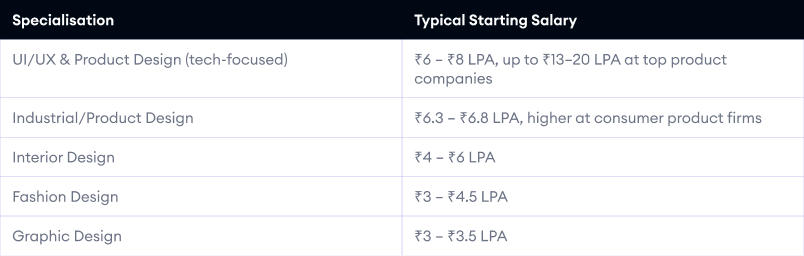
Roughly translated to a bachelor of design salary per month, that's anywhere from Rs. 25,000 for entry-level graphic or fashion roles to Rs. 50,000 or more for digital product design straight out of college. Worth noting: fashion design's lower starting salary doesn't tell the whole story, since successful independent designers and boutique founders can eventually out-earn salaried designers in other specialisations by a wide margin.
Technology and product companies, Google, Amazon, Flipkart, Myntra, and countless startups, hire heavily for UX and product design roles now. Fashion and lifestyle brands, both domestic and export-facing, recruit fashion and textile designers directly. Automotive and consumer goods companies (Tata Motors among them) hire industrial and product designers, and media, advertising, and digital platforms remain steady employers for graphic and communication designers. Design studios and agencies round out the picture for students who want varied, project-based work rather than one in-house role.
Design, more than most degrees, gets learned by doing. Live projects, real client briefs, and studio-based coursework build the portfolio that actually gets a design graduate hired, since recruiters in this field consistently care more about demonstrated work than transcript marks. Internships matter enormously too, students who complete strong ones during their degree tend to have a measurable hiring advantage over those who don't, regardless of which specific specialisation they've chosen.
AdtU's Bachelor of Design programme sits within a university holding NAAC A+ accreditation (CGPA 3.34) and UGC recognition, with a structure built around studio-based, project-driven learning rather than a purely theoretical syllabus, which matters enormously in a field where your portfolio, not your degree certificate, gets you hired. The university's placement function operates campus-wide, and the 2026 outgoing batch recorded 900+ offers through 150+ recruiters. For students in the Northeast looking at bachelor of design colleges in India without wanting to relocate to Delhi, Mumbai, or Ahmedabad just for design education, AdtU offers a genuine, accredited option closer to home. Current course fees and admission details are best confirmed directly through apply.adtu.in, since these are updated each academic year.
It can be a good choice if you enjoy creating, solving problems and working with ideas. A B.Des can lead to quite different careers - from UX and product design to fashion, interiors and communication design. The field has also grown well beyond the traditional idea of “design,” with digital products and user experience creating more opportunities for graduates.
Students passing Class 12 can apply whether they have studied Science, Commerce or Arts. Exact admission requirements can vary so it is best to check the current eligibility details before applying through the AdtU admission portal.
There is no single entrance test that every B.Des aspirant has to clear. Apart from the entrance tests of individual universities, there are a few popular options such as UCEED, NID DAT and NIFT entrance exam. Colleges may also ask for a portfolio or an interview as part of the application process.
Yes. Especially if you are interested in the design and use of digital products. Product designers work on things like websites, apps and other digital experiences. This has become an area worth exploring for B.Des graduates as companies are paying more attention to how users interact with their products.
No. Arts is not a compulsory background for a design degree. Students from Science and Commerce can apply too. What matters more is your interest in design and your ability to think creatively, solve problems and communicate ideas. The admission requirements, of course, depend on the institution.
All students on AdtU programmes are supported by the university’s dedicated placements team. The university witnessed 900+ placement offers from 150+ recruiters for the outgoing batch 2026. Students contemplating a B.Des should also consider the kind of design roles and companies they are getting placed in and not just the overall placement number.
AdtU has merit based scholarship options available for its programmes. Students applying for B.Des programmes are advised to check latest scholarship details with the admissions team before applying as the amount and eligibility criteria may vary. Please check the university admission portal for the latest updates.


